
Blog
Case Study
Carpisa.ro: From Shop Inventory to Online Orders
Carpisa
A custom WordPress store by CreateGo, with stock updates by colour and size, product content from the parent brand, bilingual publishing and a promotion engine that automatically makes the cheapest eligible fourth item free.
Explore the gallery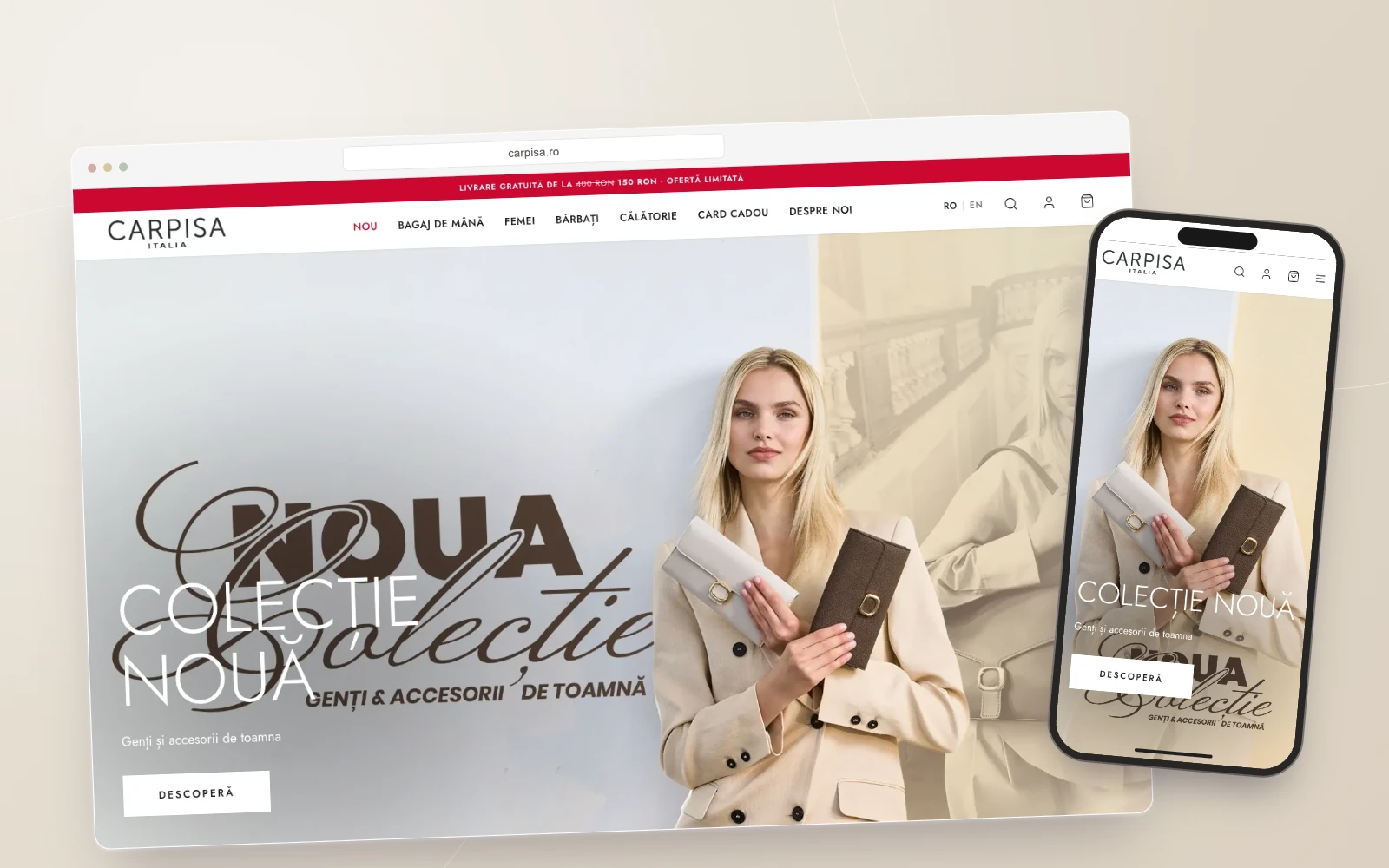
A good online store should make shopping feel simple, even when the work behind it is complex. For Carpisa.ro, CreateGo built a custom WordPress implementation that connects the customer experience with stock movements, incoming merchandise, product content and promotional rules. The result brings the storefront and the daily work of retail into the same flow.
The brief went beyond presenting a collection attractively. A customer needs to know whether a particular colour and size are available, while the team needs to keep the catalogue current without rebuilding every product page by hand. We designed the store around both sides of that experience.
Stock that follows sales, down to colour and size
Stock updates run daily when sales have taken place in the physical store that day. The update works at the level of individual variants, including colour and size, so availability reflects the particular item a customer wants to buy. This is a daily synchronisation workflow tied to shop sales.
When stock runs out for a particular colour, that colour is crossed out on the product page. The customer can see that the option exists but is unavailable, and can look at the remaining choices before continuing. A small visual detail makes the stock information useful at the exact moment of selection.
From a new warehouse delivery to a current catalogue
New merchandise brings another recurring task: identifying products and preparing their online presentation. When newly purchased goods arrive at the warehouse, the workflow uses the new invoice and product names to update the catalogue. Product photographs and descriptions are retrieved from Carpisa.it, the parent brand's website.
This connects incoming stock with the material needed to sell it online. Instead of separately looking up each new product and copying its presentation by hand, the team has an automated path from the incoming merchandise to updated product imagery and descriptions, grounded in the brand's own content.
Two languages, with automatic translation and editorial control
The store supports two languages. New content can be translated automatically, while the team retains the ability to correct it manually. Automation takes care of the first pass; editorial control remains available for product terminology, phrasing and details that need a more careful treatment.
That balance matters for a catalogue that continues to change. Adding new merchandise should not mean starting the second language from scratch, and a translation should still be easy to improve when the team sees a better way to explain a product.
A 3+1 offer with the right item made free
The promotion system handles a rule that needs more care than a simple percentage discount: choose three products from the promotion and receive a fourth free. Among the four eligible items, the algorithm always identifies the cheapest and applies the free-item benefit to that product.
The selection is made by the system rather than left to the customer to calculate. This gives the offer a consistent rule in the shopping flow and turns the commercial idea behind the campaign into working checkout behaviour.
Orders also support the next customer conversation
An integrated newsletter system supports automated communication based on orders. The connection makes order information part of the newsletter workflow, linking the purchase experience with the store's ongoing communication instead of treating those activities as completely separate tasks.
Mobile shopping, SEO, payment and delivery
The storefront is optimised for mobile use and SEO. Product browsing, variant selection and the path towards an order were considered together, so customers can move through the store on a phone as well as on a larger screen. The product presentation serves both the shopper looking for details and the store's visibility in search.
Payment and delivery are integrated into the purchasing flow. They complete the experience that begins on the product page: discover an item, check the available variant, understand the promotion and continue through the steps needed to place an order.
WordPress, shaped around the business
WordPress provides the foundation, with custom development by CreateGo connecting the workflows that make this store distinctive. Stock synchronisation, invoice-driven catalogue updates, bilingual content, newsletter automation and promotional logic work alongside the design customers see.
Carpisa.ro shows what a retail website can become when the implementation follows the business behind it. The most useful improvements are not always the loudest ones: a colour clearly marked as unavailable, a new product with the right imagery, or a promotion calculated correctly can make the store easier to run and easier to shop.
Key Points
- Custom WordPress development by CreateGo
- Daily stock updates when shop sales occur, by colour and size
- Sold-out colours crossed out on the product page
- Invoice-driven updates with product images and descriptions from Carpisa.it
- Two languages, automatic translation and manual corrections
- 3+1 promotion: the cheapest eligible item is automatically free
- Integrated newsletter automation based on orders
- Mobile and SEO optimisation, with integrated payment and delivery
A closer look
From desktop to mobile.
Explore the website through real screenshots. Open any image to see the details.
The desktop experience
The mobile experience
Screenshots of the public website captured on . The design and content reflect the public version of the website at the time of capture.
Ready to grow your business?
Apply what you've read — get a free consultation from the CreateGo team.